

The Case for Pedestrian-Oriented Development
Every city needs something like the Beltline

Odds and ends:
I had the privilege of interviewing a group of smart Philadelphians about their big ideas for Philadelphia’s forsaken Market East neighborhood (Philadelphia Magazine).
Media diet this week: Jesse Jackson’s Keep Hope Alive speech, what to do with boomers who shouldn’t drive but are car-dependent, and is the 3rd place dead?
If this newsletter gives you interesting ideas and things to talk about, or makes you feel inspired, please consider supporting it with a paid subscription!
For decades, American cities have tried to leverage transit infrastructure with transit-oriented development (TOD). It’s the cornerstone of smart growth: build dense housing and commercial space around rail stations and bus corridors and you can reduce car dependence, get residents to jobs more easily, and generate economic activity. Most cities have designated special TOD zones, offered density bonuses to developers willing to build near stations, rezoned corridors to encourage mixed-use density, and poured plenty of federal, state, and local money into TOD. It’s the holy grail of urbanism — infrastructure, housing, and jobs.
And we should keep doing that!
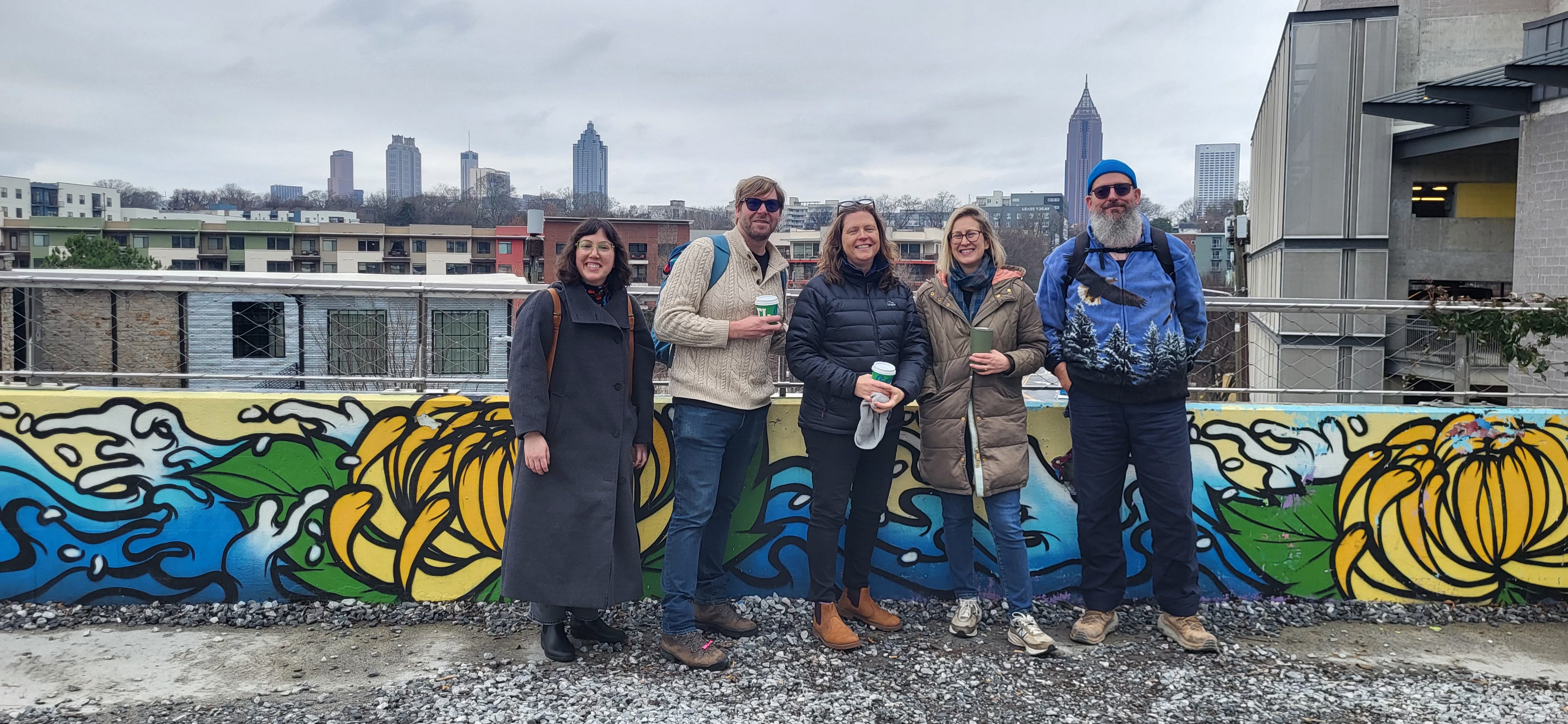
But when I walked the Beltline in Atlanta last month (ashamedly, for the first time despite the Beltline being 20 years old now), as part of my subscriber-only event in January, I found myself thinking maybe we should also be investing just as seriously in pedestrian-oriented development.
It’s abundantly clear that the Beltline has transformed Atlanta. Read that again and fully take it in: Atlanta — the poster child of 1990s and 2000s sprawl — has been transformed by a pedestrian and cycling trail.
A 22-mile loop of multi-use path threading through a necklace of former rail corridors and brownfield land has activated unproductive post-industrial land, transformed neighborhoods, and drawn a cross-section of Atlantans to share in public space — even though the Beltline doesn’t have the light rail that was initially promised. People want to live near the Beltline, and Atlanta-born companies like Mailchimp want to locate their offices on it. Much like TOD creates a gravitational pull toward transit infrastructure, pedestrian and cycling-oriented development could turn scarcity of high-quality pedestrian environments into our cities’ economic powerhouses.


In 1 999, Georgia Tech student Ryan Gravel delivered a master’s thesis argued that Atlanta’s historic freight lines should be repurposed for mass transit, creating a new focal point to limit the city’s sprawl. He envisioned dozens of stations connecting to MARTA's existing rail spokes. The line would be modeled on Portland's MAX — at-grade crossings, overhead power, simple modular station design — and would serve both existing neighborhoods and new transit-oriented development on adjacent brownfields. Gravel’s Beltline concept found a receptive audience in Shirley Franklin, Atlanta’s mayor from 2002 to 2010. Trails and parks were added to the vision later, and when the project was officially launched in 2005, it carried both ambitions.
The pedestrian infrastructure proved far easier to finance, permit, and construct than the rail component — and it worked. The Eastside Trail opened in 2012 and immediately drew crowds, development, and national attention. The trail created the demand that transit planners had been hoping light rail would create.
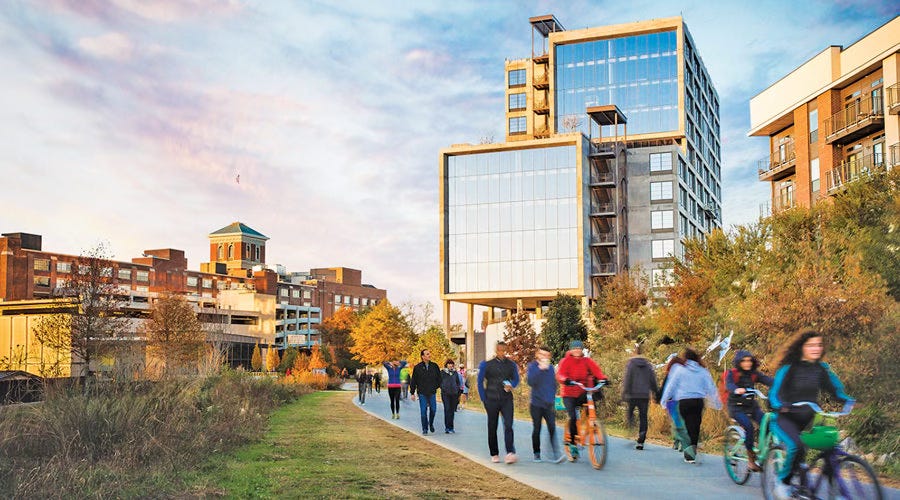
Despite failing to create light rail, the Beltline has served that goal of reinvigorating the core of Atlanta and encouraging the region to densify rather than endlessly sprawl outward. More than 4,000 units of housing have been developed within the Beltline’s Tax Allocation District — a special taxation zone that has raised $750 million for the Beltline. And donors have raised nearly $250 million more for the project. In the project’s first 20 years, it’s catalyzed $10 billion in private investment surround the Beltline. (These and other highlights from the first two decades of the Beltline can be found here.)
And something else is happening: rather than offer the prescribed light rail, the Beltline has become a haven for e-bikes. People are taking full advantage of the Beltline and its interconnected trails and spurs to commute, sometimes faster and more safely than driving. As more e-bike sharing options have become available in the less affluent Westside neighborhoods, the Beltline’s biking infrastructure is becoming more accessible to a wider swath of Atlantans. It turns out that trails are transportation, too.
Now there is a renewed push to bring traditional transit back to the Beltline. MARTA has targeted 2028 for operational streetcar service on part of the corridor. But in March 2025, Atlanta’s mayor withdrew support from the Streetcar East Extension, redirecting focus to a different corridor. The window may be closing. Having spent years letting the pedestrian investment mature, the city now faces a transit retrofit on a corridor that has already been built out around foot traffic and bicycles — a harder and more expensive proposition than building transit and trails together from the start.
The Beltline’s trajectory begs us to wonder: Why aren’t we building pedestrian and cycling realms from scratch to capitalize on the obvious demand for this product in more cities, and in more places than just abandoned rail lines?